
AI can already do a lot of the work that used to sit squarely on an analyst’s desk. It can write SQL, summarise a dashboard, explain a metric movement, spot an anomaly, draft insight commentary, interpret an experiment, translate a data pull into a stakeholder-friendly narrative, and suggest the next question worth asking.
None of that is really in question any more. The models are good enough.
The problem is not whether AI can produce an answer. The problem is whether the business can trust that answer enough to act on it without an analyst quietly checking everything behind the scenes first.
If every AI output needs to be reviewed by an analyst, AI has not removed the workload. It has created a new review queue.
That is the central tension in every AI analytics pilot I have seen get stuck. It is not a model problem. It is a trust problem — and trust has to be built the same way it always has: by testing, scoring, and monitoring the work.
What are evals?
“Evals” is shorthand for evaluations — structured tests used to measure whether an AI system is producing acceptable outputs for a specific task. The word comes from foundation model research, but the idea is not exotic. It is quality assurance, applied to AI-generated work.
An eval can test:
- Accuracy
- Completeness
- Relevance
- Reasoning quality
- Consistency
- Usefulness
- Safety
- Format compliance
- Factual grounding
- Data correctness
- Whether the answer follows the business’s own rules
Evals are not just something foundation model labs run before a release. They are a practical tool for any business workflow where an AI system’s output matters. For an AI analytics assistant, a useful eval asks questions like:
- Did the AI use the correct metric definition?
- Did it query the correct table?
- Did it compare against the right time period?
- Did it identify the true driver of the change, or just a correlated one?
- Did it avoid overstating causality?
- Did it explain its own uncertainty?
- Did it produce an answer a stakeholder could actually act on?
None of that is glamorous. It is exactly the kind of thing a good analyst already does instinctively when they check their own work before sending it. Evals are what it looks like to make that instinct repeatable, and to run it automatically instead of relying on someone remembering to do it every time.
Why analytics is especially dependent on evals
Some AI use cases are low-stakes. A slightly-off email draft gets edited before it’s sent. A mediocre first pass at a blog outline gets rewritten. Analytics is not that kind of use case.
Analytics outputs routinely feed into:
- Trading decisions
- Marketing spend allocation
- Product prioritisation
- Experiment rollout decisions
- Forecasting
- Customer experience changes
- Senior leadership reporting
A wrong answer in this context does not usually look wrong. It looks polished, confident, and entirely plausible — because that is exactly what a language model is good at producing.
In analytics, the danger is not that AI cannot answer. The danger is that it answers confidently with just enough truth to be believed.
The failure modes are rarely dramatic. They are small, structural, and easy to miss unless you already know where to look:
- Comparing this week to a partial previous week
- Mixing users, sessions, and events as if they were interchangeable
- Treating correlation as causation
- Joining tables at the wrong grain and silently duplicating revenue
- Ignoring a tracking change that shifted the baseline
- Misreading experiment exposure logic
- Using average order value where revenue per visitor was the right metric
- Forgetting that GA4 event data is sparse and context-light by design
- Explaining a metric movement without checking whether traffic mix shifted underneath it
- Summarising a dashboard while missing the one caveat that actually mattered to the business
Every one of those is the kind of thing an experienced analyst catches almost without thinking. None of them are the kind of thing a language model reliably catches on its own, because a language model has no innate concept of “this number is wrong” — only “this text is fluent.”
The current state: humans are the eval layer
Look closely at most AI analytics workflows in production today, and you’ll find the analyst is still doing the job evals should be doing.
The typical loop looks like this:
- A stakeholder asks a question.
- The analyst asks AI for help — a query, a summary, a first-pass explanation.
- AI produces SQL, commentary, or analysis.
- The analyst checks the query, checks the data, checks the logic, and edits the narrative.
- The analyst sends the answer, under their own name.
That loop can genuinely save time. It is also not transformative, because the analyst remains accountable for everything that matters: data correctness, interpretation, business logic, edge cases, stakeholder framing, and the final recommendation. AI has taken over the typing. It has not taken over the judgement.
This is why so many AI analytics pilots feel impressive in a demo and then quietly plateau. They save time in pieces of the workflow without ever removing the need for expert validation of the whole thing — because nothing has replaced the validation. It’s the same trap that made self-serve analytics fail to deliver on its promise for over a decade: more access to output, no more trust in it.
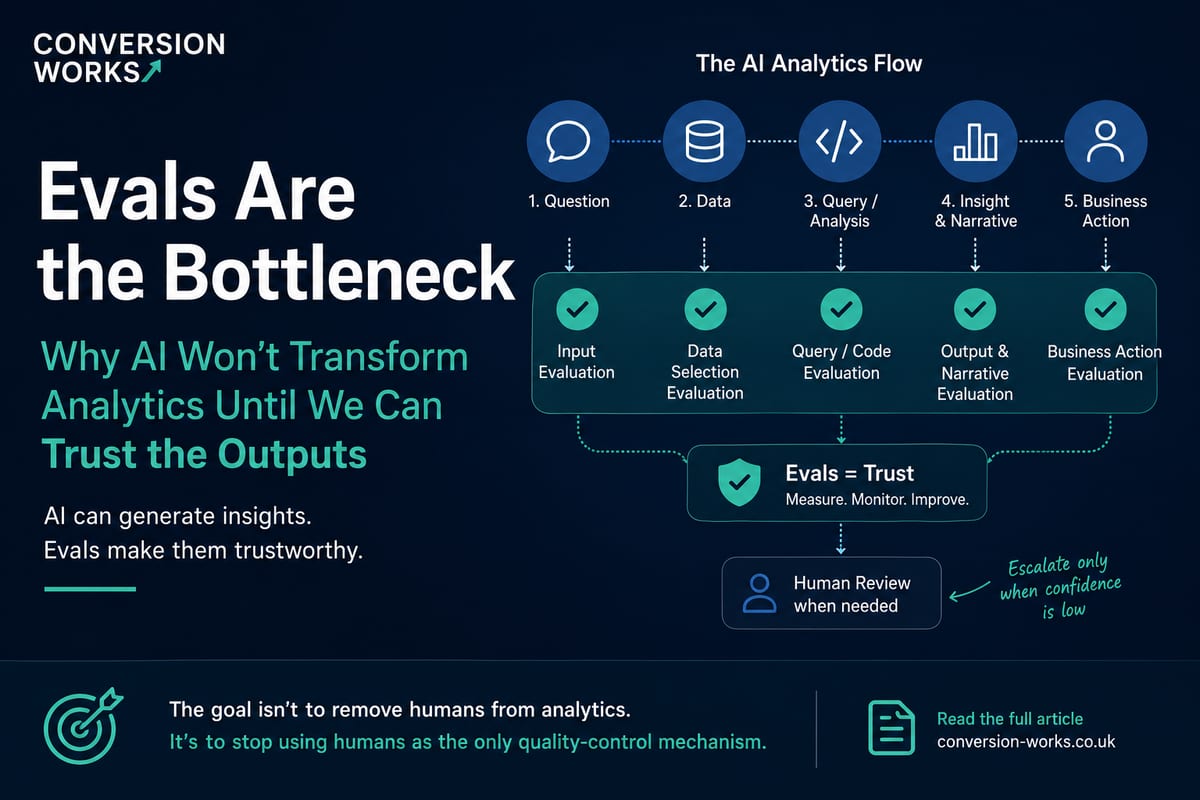
Where evals fit in the AI analytics workflow
Evals are not a single test you bolt on at the end. They belong at several points in the workflow, each catching a different class of failure.
1. Input evaluation
Before AI does any work, check whether the request is actually answerable as asked.
- Is the user asking a measurable question?
- Are the required metrics defined?
- Is the time period clear?
- Is there enough business context?
- Is the question answerable from the data that’s actually available?
“Why are sales down?” is not a question yet. It becomes one once sales is defined, the time period is fixed, the channel or product scope is clear, and the comparison baseline is agreed. An eval at this stage forces that clarity before any compute is spent on an answer nobody can trust.
2. Data selection evaluation
Check whether AI picked the right source, not just a plausible-looking one.
- Correct table
- Correct metric source
- Correct level of aggregation
- Correct filters
- Correct business definitions
For ecommerce conversion, should the AI use GA4 purchase events, backend order data, or finance-recognised revenue? Those three numbers can legitimately disagree by double digits, and an AI system that picks whichever is easiest to query — rather than whichever is correct for the question — will produce a fluent, wrong answer.
3. Query and code evaluation
If AI is writing SQL or Python, the logic itself needs checking, not just the output it produces.
- Join keys
- Date filters
- Aggregation level
- Null handling
- Duplicates
- Metric definitions
- Window functions
- Experiment assignment logic
- Use of partial periods
This is the layer where the same kind of context and governance problems that plague raw event data show up again — except now they’re embedded inside AI-generated code that looks authoritative because it runs without error.
4. Output evaluation
Evaluate the answer itself, not just how it was produced.
- Does it answer the question that was actually asked?
- Is it supported by the data behind it?
- Are the numbers quoted correctly?
- Are the right caveats included?
- Is uncertainty explained rather than smoothed over?
- Is the recommendation proportionate to the strength of the evidence?
5. Narrative evaluation
Analytics is not just numbers — it’s communication, and a technically correct answer can still fail if nobody can act on it.
- Is the insight clear?
- Is it understandable to the stakeholder who has to act on it, not just to another analyst?
- Does it avoid unnecessary jargon?
- Does it separate fact, interpretation, and recommendation, rather than blending them into one confident paragraph?
- Does it avoid overclaiming?
6. Business action evaluation
Check whether the output leads somewhere sensible.
- Is the recommendation actually actionable?
- Does it match the strength of the evidence behind it?
- Is it commercially sensible?
- Does it identify what to check next, where relevant?
- Does it avoid suggesting risky action off the back of weak evidence?
7. Ongoing monitoring
Evals are not a one-off gate. Once a workflow is live, they need to keep watching it.
- Are outputs getting worse after a model or prompt change?
- Is the prompt drifting from what it was validated against?
- Are new data schemas quietly breaking answers?
- Are certain question types failing more often than others?
- Are users accepting poor outputs anyway, because checking takes longer than using?
- Is the rate of human override going up or down over time?
Types of evals for analytics outputs
Different failure modes need different kinds of test. In practice, most mature setups use all five of these together.
Rule-based evals
Best for anything with a clear right or wrong answer. Cheap, fast, deterministic, and easy to automate — but they can’t judge deeper reasoning or usefulness.
Examples: the output must include a confidence level; the SQL must include a date filter; the query must not reference a deprecated table; the numbers in the summary must match the numbers in the result set; an experiment readout must state its sample size; the output must contain a caveat whenever the underlying data is incomplete.
Golden dataset evals
A set of known questions with trusted, agreed answers — “Why did conversion drop on mobile last week?”, “Summarise experiment X”, “Explain the movement in paid search revenue”, “Find the top drivers of checkout abandonment.” For each one, you store the input question, the required data source, the expected method, the accepted answer, the key caveats, and a scoring rubric.
These are excellent for regression testing and for comparing prompts, models, and workflows against each other on equal footing. The cost is upfront effort, and they need refreshing as business definitions change.
Human-rated evals
Humans score AI outputs against a rubric covering correctness, usefulness, completeness, clarity, commercial judgement, and risk. Good for nuanced judgement, especially early on — but expensive and slow unless the criteria get converted into something more repeatable over time.
LLM-as-judge evals
A second AI model scores the first one’s output — useful for clarity, relevance, completeness, instruction-following, and whether caveats are present. It scales far better than human review, but the judge can also be wrong, needs calibrating against real human judgement, and is not a substitute for checking hard numerical truth unless it’s grounded in the actual source data.
Data-grounded evals
Compare claims in the answer directly against the underlying data. If the AI says revenue dropped 12%, the result table has to confirm 12%. If it says mobile was the largest driver, the contribution analysis has to back that up. If it says the issue started on Monday, the time series has to show that. This is the single most important eval type for analytics specifically, because it is what catches hallucinated or unsupported numbers before a stakeholder sees them.
Adversarial evals
Deliberately difficult or misleading cases — ambiguous questions, missing context, conflicting metrics, partial data, tracking changes, seasonality traps, Simpson’s-paradox-style segment reversals, experiment results with sample sizes too small to mean anything. Harder to design, and they need real domain expertise, but they’re what surfaces the failure modes nobody thought to test for directly.
What evals are good at
Evals earn their keep on repeated, clearly scoped work: known business definitions, structured outputs, SQL generation checks, dashboard commentary, regression testing, comparing prompts and models against each other, monitoring quality over time, catching obviously bad outputs before they ship, setting confidence thresholds, and generally making the move from pilot to production survivable.
Evals turn AI quality from a feeling into a measurable operating process.
What evals struggle with
It would be dishonest to present evals as a solved problem for every kind of analytics work. They are harder, and sometimes not really the right tool, when:
- The question is genuinely vague
- There is no single correct answer
- The analysis requires commercial judgement rather than calculation
- The underlying data itself is wrong or incomplete
- Business definitions are actively contested inside the organisation
- The output depends on organisational context an eval can’t see
- The “right” answer changes depending on who’s asking and why
- Success is inherently subjective
- The task is strategic rather than analytical
- AI would need to decide what matters, not just answer what it was asked
“What should we do about declining sales?”, “Which customer problem matters most?”, “Was this experiment worth rolling out?”, “What’s the story behind this trading performance?”, “Which metric should leadership actually care about?” — none of these have a scorable right answer. Evals don’t remove the need for humans in questions like these. What they do is make it obvious which questions are which, so human judgement gets spent where it’s genuinely needed instead of being burned re-checking arithmetic.
The analytics maturity model for evals
Most organisations sit somewhere on this ladder, usually without having consciously chosen where:
- 0
No evals
Every AI output is manually checked, every time. No repeatable test, no scoring, no memory of what failed before.
- 1
Informal review
Analysts use AI and review outputs based on experience and gut feel. Quality depends entirely on who is checking.
- 2
Checklist-based review
Teams use a standard checklist for common AI analytics outputs — a first, informal step towards consistency.
- 3
Repeatable test sets
Known questions with trusted answers are used to test prompts, workflows and models before they ship.
- 4
Automated eval pipelines
Outputs are automatically scored for correctness, completeness, format and data grounding — with no human in the loop for the check itself.
- 5
Operational AI analytics
AI handles defined classes of analytics work with automated evals, confidence scoring and escalation rules. Humans review only what genuinely needs them.
The goal is not to remove humans from analytics. The goal is to stop using humans as the only quality-control mechanism.
How to start building evals for analytics
Step 1 — Pick one narrow workflow. Not “an AI analyst for everything.” Good starting points: weekly trading commentary, experiment summaries, dashboard anomaly explanation, SQL generation for a known data mart, GA4 journey analysis, an ecommerce performance readout, or explaining a marketing channel movement.
Step 2 — Define what good looks like. Build a rubric: correct metric, correct time period, correct data source, correct calculation, clear explanation, appropriate caveats, a supported recommendation.
Step 3 — Collect 20–50 real examples. Use actual stakeholder questions and the answers a trusted analyst already gave them.
Step 4 — Turn those examples into test cases. Each one needs the input question, context, the data that was available, the expected method, the characteristics of a good answer, known traps, and scoring criteria.
Step 5 — Automate the easy checks first. Format compliance, required sections, SQL safety, deprecated table checks, metric definition checks, number matching, date range validation.
Step 6 — Add human scoring where judgement genuinely matters. Let analysts score subjective quality at first, and use that scoring to refine the rubric.
Step 7 — Use AI judges carefully. Model-based grading works well for clarity, completeness and instruction-following — but calibrate it against human scores before trusting it.
Step 8 — Add escalation rules. Route to a human when confidence is low, data is incomplete, metric definitions conflict, the recommendation involves major spend or strategic action, the answer depends on causality, or the system detects genuine ambiguity.
Step 9 — Monitor over time. Track pass rate, failure types, human override rate, user satisfaction, rework required, false confidence, and regression after model or prompt changes.
Example analytics eval rubric
| Evaluation area | What it checks | Example pass condition | Example failure |
|---|---|---|---|
| Metric definition | Whether the AI used the correct metric | Uses revenue per visitor, not conversion rate, where commercial impact was requested | Optimises for sessions instead of users |
| Time period | Whether the comparison window is correct | Compares full week vs full previous week | Compares a partial week to a full week |
| Data source | Whether the right table or system is used | Uses backend orders for revenue reporting | Uses GA4 purchase events when finance-level revenue was needed |
| SQL logic | Joins, filters, aggregation and grain | Joins at user level before aggregating | Duplicates revenue through a one-to-many join |
| Evidence | Whether claims are supported by data | States “mobile drove 68% of the decline” with the contribution analysis to back it | Says “mobile is the issue” with no supporting breakdown |
| Caveats | Whether uncertainty is disclosed | Notes a tracking change or a small sample size | Presents weak evidence as if it were certain |
| Recommendation | Whether the next step is proportionate | Recommends further investigation before a full rollout | Recommends major action from thin evidence |
The biggest mistake: evaluating the model instead of the system
The question most businesses ask is “which model is best?” It’s the wrong question for analytics.
The question is not “which model is best?” The question is “does this system produce trusted outputs for this workflow?”
The system is never just the model. It’s the model, the prompt, the data access layer, the semantic layer, the metric definitions, the retrieval process, the SQL generation, the output format, the evaluation layer, the escalation process, and the human feedback loop that feeds back into all of it.
A strong model sitting on top of poor data context will produce bad analytics. A weaker model with excellent guardrails, clear definitions, and real evals behind it will often outperform it in production. This is the same lesson analytics has been relearning for years in a different guise: the collection layer and the definitions underneath a metric matter more than the sophistication of whatever sits on top of it.
Evals as the foundation for analytics automation
Analytics teams are overloaded for a simple reason: demand for insight always outpaces the supply of people who can produce it reliably. AI can genuinely close that gap — but only for the work it can safely take on, and “safely” is doing a lot of work in that sentence.
Evals are what let a team decide, with evidence rather than optimism, which tasks AI can handle. They measure output quality instead of assuming it. They reduce manual checking instead of just relocating it. They build confidence over time instead of demanding it up front. They show where human analysts add the most value, instead of leaving that to guesswork. And they turn one-off AI experiments into reusable, monitored workflows.
Without evals, AI stays a productivity aid for individuals — genuinely useful, but bounded by how much any one person can personally verify. With evals, AI becomes part of the analytics operating model itself.
The takeaway
AI analytics will not get adopted at scale because the outputs are impressive. It will get adopted when the outputs are measurable, testable, monitored, and trusted. Impressive and trustworthy are not the same property, and analytics is one of the few domains where confusing them is genuinely expensive.
Evals are not a technical side quest bolted onto an AI project. They are the operating layer that decides whether AI actually relieves an analytics team or just creates a new stream of work for analysts to double-check.
The analytics team of the near future will not just write reports and answer questions. It will design the systems, definitions, tests, and evals that let trusted insight scale beyond what any one analyst could personally verify — a shift that’s already reshaping what the role is for.
AI analytics eval starter checklist
A short list to work through before putting any AI analytics workflow into production:
- Define the workflow — narrow, not “AI analyst for everything”
- Define what a good output looks like, in writing
- Identify the common failure modes for this specific workflow
- Collect 20–50 real test cases from actual stakeholder questions
- Build simple rule-based checks for the easy, objective things
- Add a human review rubric for the judgement calls
- Add an LLM judge where it’s useful, calibrated against human scores
- Add data-grounded checks so claims are verified against real results
- Define clear escalation rules for low-confidence or high-stakes cases
- Monitor pass rate and override rate over time — not just at launch
Want to make AI genuinely useful inside your analytics function? Conversion Works helps teams design practical AI analytics workflows, evaluation frameworks, and data products that move AI from experimentation to trusted operational use. Get in touch if that’s the problem you’re trying to solve.